United Horned Hair Sheep Association, Inc. |
These are the standards that all breeders should do their best to have as breeding goals. Some
standards are required for registration and a complete list of standards which are required for
registration is listed afterwards.
Traits discriminated against, traits which are suggested to be used minimally in breeding the
sheep, are a fault and are not a disqualification and animals exhibiting faults in one area or another
are still able to be registered. An animal displaying a trait that is listed as a disqualification is NOT
able to be registered or recorded. Sheep which do not exhibit the requirements for registrations are
considered to be disqualified and not eligible for registration.
GENERAL APPEARANCE:
The General Character and Appearance of the Sheep represented by the United Horned Hair Sheep
Association, Inc., should be one of a noble animal. The sheep should look like an athlete with a
lean, sleek form. The sheep are not purely a meat breed but are more for multiple markets (Click
Here for more information about multiple markets) and may not necessarily weigh nor exhibit the
deep and heavy muscling of sheep which are considered purely meat breeds.
HEAD:
Should be well balanced and proportional to the body and held high when the sheep is alerted.
Ewes should have a more feminine face and features than the rams.
The back of the head of mature rams may display a slight to extreme rounded hump behind the
horn base. This is part of the rams’ physical frame which helps cushion the brain during any
sparring.
NOSE:
Young lambs typically have a straight profile.
As ewes age, some may display a slight roman nose (elevated area on the nose bridge seen when
viewed from the side profile) while many will maintain the straight profile.
As the rams age, a slight to moderate roman nose (elevated area on the nose bridge seen when
viewed from the side profile) may be displayed. One may note a bigger elevation on the nose bridge
during times association with breeding cycles or during an increase in sparring activity among
rams.
The nose and muzzle area are generally lighter in color than the body of the sheep. This lightness
combined with lighter legs than body leads many to call these Red Dalls or Champagne Dalls. The
lighter color areas do not have a definite perimeter where the light color (sometimes totally white)
ends. It is more of a blending of the colors leading to a gradually lighter color.
Sometimes, the sheep, including the nose and muzzle area are almost a solid color similar to the
body of the sheep or a shade darker.
Nose pads of most Desert Sand Sheep are generally pink with some light pigmentation around the
nostrils. The type of Desert Sand with lighter to white faces should have pink nose pads while the
solid sheep may exhibit some darker nose pads. There may be varying degrees of pigmentation
around on the eyelid margin. No distinct black spots or other distinct spotting on the nose or nose
pads is allowed.
COAT:
Desert Sand Sheep are considered a hair or shedding sheep. These sheep actually have two
coats: a hair type coat and usually a more wooly undercoat. The undercoat may resemble a thicker
hair to a more wool type look and texture. This undercoat grows during cool weather and will
naturally shed off when warmer weather arrives.
In colder climates, some sheep may exhibit a fuller winter undercoat; however, the undercoat
should completely shed off without shearing when warm weather arrives with the exceptions of
lambs and some yearlings.
The ability of the sheep to grow and shed the undercoat, may lead to only partial shedding for a time
in various climates. A complete shedding generally occurs by May, June or early July. The exact time
for a complete and natural shedding depends on the climate. Lambs and some yearlings may not
shed totally till the next year.
Desert Sand Sheep with possible close Mouflon breed influence, may have a slight shedding of
coarse guard hairs in the fall, dependent of the climate.
The complete and natural shedding ability is important in maintaining ease of care and a lack of
such shedding may be indicative of parent breeds in the background that are not desirable or of
having wool parent breeds in the recent background.
COAT COLORS:
Desert Sand Sheep generally have a dark body, ranging from light champagne, light cinnamon, to
light copper with gradually lighter colored faces and legs and belly. Some sheep may have a more
overall solid color and be medium to dark champagne, cinnamon, or copper.
There should be no distinct spotting of any color other than white saddle patches for sheep with
strong Mouflon influence. Color changes should be gradual. Distinct spotting, other than the white
saddle patches which are allowed, is a disqualification for registration as a Desert Sand. Instead,
the sheep could possibly be registered as a Painted Desert.
COAT PATTERN:
Category 11: Two-Toned. The sheep generally exhibits a darker body with a
gradual lightening of color so that the extremities and/or face are white or
almost white.
Category 12: Solid. The sheep has an overall solid color and does not display
lighter face and/or extremities.
EARS:
Ears should be parallel to the ground or at slightly higher angles. A very slight angle below parallel
to the ground is noticeable at times; however, the ears should become parallel to the ground or
higher when on alert.
While at birth, lambs may display droopy ears, especially those who are part of a multiple birth;
however, the ear(s) should straighten up within a few days. Otherwise, ears must not droop enough
to be considered floppy. Such ears would tend to indicate cross-breeding in the background of the
sheep. Naturally occurring (not due to injury or other difficulties) droopy ears are a disqualification
for registration.
Ears generally should come to a slight point at the tip and not be completely rounded in shape. Elf
ears (ears with external cartilage which is generally 1/2 inch to 3 inches in length and exhibiting a
more v-shaped ear) and Gopher ears (ears without visible extenal cartilage or with less than 1/2
inch) are acceptable. Natural ears may vary in length but are generally in the range of 3 - 4 inches.
Abbreviations used within the registry are as such: E indicating Elf Ears, G indicating Gopher Ears,
and N indicating Natural Ears.
EYES:
Eyes should be bright and alert and must be free from genetic eyelid defects such as Entropion.
The color of the eyes vary from dark brown, golden brown to amber.
INCISOR TEETH:
Incisor teeth should meet the dental pad. A severe and distinct space between the incisor teeth and
the dental pad is a disqualification.
Sheep should not have an extreme overbite (parrot mouth) or underbite (monkey jaw).
CLICK HERE to learn how to estimate the age of your sheep by looking at the teeth!
NECK:
Neck should continue from the head and gradually lead into the shoulders and be gracefully held
when sheep are alert.
A ewe’s neck will be graceful and proportional in size based on the ewe‘s overall frame.
A ram’s neck will be thicker and more muscular than a ewe‘s neck in appearance and to the touch.
During the Fall or cooler weather, rams may display an increase in hair and undercoat growth
around the neck area which will make the neck look much larger.
MANE:
Mature rams will display a mane in the winter. Some rams will shed the mane completely in the
summer while others will retain the mane. Some ewes may also have a short mane.
A ram’s mane may be varied in length from short to long, some even almost touching the ground
when in full winter coat. Some manes may be much shorter and hang just a couple of inches below
the bottom line of the chest. A ram with no mane at any time is a severe fault and is discriminated
against.
SHOULDERS AND WITHERS:
The shoulders should be developed and muscled proportionally to the size of the sheep. They
should flow into the ribs (well laid into the ribs).
The withers (area between the shoulder blades along the top line) may be elevated with rams
exhibiting a more pronounced and higher elevated wither. Some sheep may have a completely
straight topline and no elevation at the withers.
CHEST:
The width of the chest of most Desert Sand Sheep will be narrow to moderate with a more athletic
look - proportional to the size of the sheep.
The width of the front of the sheep should not be greater than the width of the back of the sheep to
facilitate lambing.
BACK:
Continuing after a smooth transition from straight or elevated withers, the back should be strong,
level and relatively smooth. The Back may tend in width to look lean, sleek, and athletic.
The back is proportioned to the height of the sheep and is generally not longer than the height.
Ribs should be well sprung. Abdomen should allow for multiple births and be proportional for
smaller sized ewes; however, Mouflon sheep and high content Mouflon ewes are primarily shaped
and geared toward single births.
BOTTOM LINE:
The bottom line should not be tucked in at the fore flank nor the rear flank.
LEGS:
The Legs should be sound and proportioned to size of individual sheep. Sheep will have long
athletic legs, usually longer than body height from bottom line to top line.
Rams will generally have thicker legs then ewes.
Legs should have a conformationally correct appearance. Front legs should not be knock kneed,
bowlegged, buck-kneed or calf kneed. Rear Legs should not be cow hocked, sickle hocked or post
legged. Lower Legs on both front and rear legs should not toe in (angle inward/pigeon toed) or toe
out (angle outward/splayfooted) too much. Pasterns should be strong and correct.
See Leg Diagrams to the right for illustrations.
A nice four square stance is desired with legs standing nicely inline with the body of the sheep.
RUMP:
Continuing from the back, the rump should exhibit a gradually angled slope to the dock.
Size and muscling of rump are proportional to the size of the overall sheep.
THIGH:
The Thigh should be well developed in proportion to the size of the sheep. Black Hawaiian Sheep
may not display the depth and heavy muscling of some sheep breeds developed purely for fast gain
and high weights (meat) at an early age.
TWIST:
The twist is the junction where the insides of the thighs meet. To compare sheep as far as meat
capability, the measurement of the depth of the twist may be taken. To measure the depth of the
twist, one can place hands at the top of the tail and at the crotch. This measurement assists
especially in judging of pure meat sheep breeds and shows the depth of muscling in this area. SEE
ILLUSTRATION TO THE LEFT
The Desert Sand Sheep tend toward the depth of the twist being minimal to moderately deep. The
Twist should be muscled proportional to the size and frame of the individual sheep.
UDDER:
A ewe’s udder should be well proportioned and relatively symmetrical and have only two teats. A
ewe with more than two teats is discriminated against. The teats should be free of obvious defects
affecting function.
SCROTUM:
Both Testicles should be uniform and symmetrical, free of obvious deformities. Testicles should be
well sized and the scrotum itself should also be free of obvious deformities.
SEE SCROTUM/TESTICLES DIAGRAM BELOW RIGHT.
TAIL:
Tail lengths vary. Shorter tails are preferred. Tails should not be “round” and should be more “flat
“.
A tail that is reaching to the hocks is discriminated against. A tail past the hocks is a
disqualification from registration in the United Horned Hair Sheep Association, Inc.
SEE TAIL LENGTH ILLUSTRATION BELOW RIGHT
HOOF:
Hooves should be well formed and kept free of deformities and disease.
Desert Sand Sheep hooves should be white to dark cream or light brown in color. Black Hooves are
a Disqualification from registration. SEE PHOTO TO THE LEFT.
HORNS:
All rams must grow and display horns, however, both polled (hornless) and horned ewes are
acceptable as are ewes with scurs. Some breeders prefer not to have scurs on their sheep due to
scurs being easily knocked off and bleeding that could occur.
Rams with scurs are not eligible for registration. To be registered, ram lambs out of unregistered
parents will need to exhibit horns in submitted registration photographs.
HORN DISTANCE FROM FACE:
In general, wide horns (horns with plenty of room from the face) are preferred over horns that may
grow close to the face and eventually touch the face. Some flock owners and breeders prefer horns
which are a little closer to face (more heart shaped) or have tight curls while other flock owners
prefer horns which have much wider areas between the face and the horns or less tight curls
(horns almost sticking straight out).
Filing or training of the horns to prevent horns from touching the face is acceptable and will not
prevent the ram from being registered. However, such activities should always be disclosed in a
honest manner to potential customers.
HORN SHAPE AND TYPE OF HORNS:
Horns can be of varying shapes. Some may be wider than others at the “tips“.
SEE PHOTOS TO THE LEFT.
Overall directional shape of horn growth
Supracervical Horns (abbreviated SH) (Heart Shaped)
Homonymous Horns (abbreviated HH) (spiraling out)
Polycerate/Multiple Horns (abbreviated MH) (multiple horns - 3, 4, +)
Actual shape of individual horns
Webbed Horns
Abbreviated SW for Supracervical shape, webbed horns
Abbreviated HW for Homonymous shape, webbed horns
Abbreviated WH for horns which do not show over all shape of horn growth yet but do show they are
webbed
Round/Usual Horns
Horns are more round in circumference. This is the most common actual horn shape.
Ewes’ horns really do not take on shapes as the rams’ horns. They sometimes can be curved
outward or backward. To indicate Horned Ewes in the registry, HE is the abbreviation used.
HORN LENGTH
A mature ram’s horn lengths vary based on actual age, individual ram (genetics), areas of the
country (environment and weather), nutrition and health. Growth rate (rate at which the horns grow)
is also dependent upon some of the above factors. Horns generally slow down during late
winter/early spring unless fed to overcome the slowdown; however, the average overall growth rate
for horns for young rams is 1 inch per month for the first two years. Some rams may seem to get a
good start with quick growing horns while others horns grow slower but then catch up as the ram
matures.
Mature rams usually display 20 - 29 inch length horns to measurements in the 30 - 39 range. Horns
generally turn outward. Bases on mature rams generally run 8 to 9 inches in circumference. Ten
inches in circumference of the base of mature rams’ horns also can be found. Eleven inches in
basal circumference (base measurements) for each horn is exceptional.
Some breeders will prefer larger base measurements as the horns grow out from the bases and
with larger base measurements, the belief is, the better future opportunity for growth exists.
CLICK HERE OR ON PICTURE TO THE RIGHT TO LEARN HOW TO MEASURE AND SCORE YOUR
RAM'S HORNS
HORN COLOR:
While shapes and lengths of the sheep breeds represented by UHHSA, Inc., are similar, certain
breeds prefer certain colors of horns. For the Desert Sand Sheep, horns should tend toward the
light to medium shades of coloring. With age, the horns may appear washed out. Black colored
and highly contrasted variegated horns are a disqualification.
SEE PICTURES TO THE RIGHT.
SIZE:
The average height of the Desert Sand Sheep is often similar to the Texas Dall Sheep. For the
ewes is 20 - 27 inches at the withers and 21 - 31 inches at the withers for rams. Individual sheep
may be outside of the range and there is no fault or disqualification for above or below average
heights.
WEIGHT:
The weight of the sheep varies and individual sheep may weigh outside the range.
Ewes may weigh 60 - 150 lbs with an average of 70 - 100 lbs. Rams generally weigh from 75 - 200
pounds with an average of 100 lbs.
BACKGROUND/HERITAGE:
Desert Sand Sheep are a naturally shedding, generally light to dark shades of champagne,
cinnamon or copper colored sheep with Mouflon Sheep influence in ancestry. All rams must have
horns, and the ewes are allowed to have horns although most ewes are polled. Rams must not
exhibit scurs instead of horns, while ewes with scurs are acceptable.
Desert Sand Sheep have been called Red Dalls and Champagne Dalls. To some the different
coloring and lighter face and extremities are just a color phase of the all white Texas Dalls. To
others, the different coloring is indicative of something other than the pure white of the Texas Dall
sheep in the background, such as possibly some Black Hawaiian or American Blackbelly or close
Mouflon influence.
The Sheep should not contain, to the best knowledge of the owner, any polled blood or other types
of polled bloodlines, including but not limited to Dorper, Katahdin, and St. Croix sheep breeds.
Horned Ancestry bloodlines accepted are Texas Dall, Mouflon, American Blackbelly, Corsican,
Black Hawaiian, Horned Rambouliet, Merino, or Navajo Churro. Because of the chance for spotting,
it is suggested that the parent wool breeds which may produce spotting in the progeny not be used.
It is not a disqualification at this time to have sheep with Jacob (a spotted wool breed) or Painted
Desert Sheep in the pedigrees; however, the goal is to produce sheep with the coloring of the
Desert Sand Sheep and the spotted genetics might interfere with that goal.
While the original crosses occurred several decades ago, some breeders may wish to create new
bloodlines using one or more of the parent wool breeds. To be registered, Desert Sand sheep
must consist of 1/8th or less of parent wool breeds and meet all other breed standards.
Desert Sand Sheep which are directly bred from wool lines and include only the listed parent wool
sheep breeds, must completely shed and additional pictures showing the completely shed sheep
may be required for registration if the pictures submitted does not clearly show the sheep shedding
or having shed.
Information about any known background of the ancestral breeds should be included in pedigrees
with their percentages of the breeds noted to assist breeders in choosing bloodlines. If a sheep is
unregistered, the animal should be clearly labeled as unregistered. This information should include
any known wool breeds in the bloodlines.
NON STANDARD COLOR PRODUCING DESERT SAND SHEEP
What to do when sheep which are registered as Desert Sand when mated with another Desert
Sand Sheep, produces non-standard coloring. Are these color producers then still considered
Desert Sand Sheep or are the offspring simply expressing a color phase? For UHHSA and the
Desert Sand Sheep Registry Division purposes at this time, a Desert Sand Sheep will be defined
as a light to dark colored champagne, cinnamon, or copper colored sheep which, when bred to the
same normally produces the same standard coloring and which has no known spotting genetics in
the known pedigrees of the sheep.
While some market opportunities do not require such distinction, for registration and breeding
purposes of a Desert Sand Sheep, production of spotting and color variances in addition to the
allowable colors listed above should matter and is highly discriminated against. Animals
displaying nonstandard coloring will not be eligible for registration as a Desert Sand Sheep.
UHHSA and the Desert Sand Registry expects it’s members to fully disclose any known spotting or
other non standard coloring that exists in their Desert Sand Flocks and work on minimizing spotting
and the chance for spotting or other non standard coloring to the best of their abilities.
While each shepherd needs to make decisions on their flock management, it is strongly suggested
that if a registered ram or registered ewe is shown to produce nonstandard coloring with different
mates, that sheep be removed from the Desert Sand breeding program.
If Any Sheep are produced which do not meet the color standards for the Desert Sand Registry,
PLEASE consider registering them with the Painted Desert Registry division of UHHSA if they match
the Painted Desert Breed Standard or another division within UHHSA if they match the division’s
Breed Standards.
TRAITS REQUIRED FOR REGISTRATION:
- Rams must have horns
- Light to dark shades of Champagne, Cinnamon, and Copper
- No distinct black spots or other distinct spotting on the nose or nose pads or body, however
white saddle patches from strong Mouflon influence is allowed - Known background of only Texas Dall, Desert Sand (Red Dalls, Champagne Dalls),
Mouflon, and wool parent breeds of Horned Rambouilet, Merino, and Navajo Churro - At this time Jacob wool ancestry as well as Hair ancestry of Black Hawaiian, American
Blackbelly, Corsican, and Painted Desert is accepted - 1/8th or less of wool parent breeds
- Sheep at maturity normally exhibiting shedding ability
TRAITS DISCRIMINATED AGAINST (considered a fault):
- Rams’ horns which touch the face at maturity
- For multi horned animals - fused horns
- Extra Teats on ewes
- Slight under or over bite, with teeth just barely touching the edge of the dental pad
- Sheep which do not shed out completely at maturity on a normal basis
- Mature rams with no mane at any time
- Tails reaching to the hocks
- Sheep with close spotting genetics
DISQUALIFICATIONS:
- Sheep with known recent polled bloodlines
- Rams which are polled or have scurs at maturity
- Tails past the hocks
- Docked tails
- Sheep with more than 1/8th known wool breeding from the parent breeds - Horned
Rambouliet, Merino, Navajo Churro, or Jacob - Sheep with any known wool breeding from any non-parent wool breed
- Hermaphroditism
- One or both testicles not descended
- Severe under or over bite, with distinct space between teeth and edge of dental pad
- Evidence of cross breeding shown by physical appearance of breeds which are not included
in the history or background of Desert Sand Sheep such as Suffolk, Hampshire, Dorper,
Katahdin, St Croix, etc. - Entropion (inverted eye lids) or other genetic eyelid defects
- Naturally occurring droopy or floppy ears on adults
- Black horns or extremely contrasted variegated horns
NOTES:
Sheep with Disqualifying traits are not eligible for registration and will be denied registration.
Excessive Discriminating traits of an individual sheep may render that sheep ineligible for
registration if, at the inspectors and board of directors discretion, such traits seriously challenge the
breed identity.
| THIS website is copyright May 2009 by United Horned Hair Sheep Association, Inc. Active Members of UHHSA are permitted to use information on their website to help in ethical and honest promotion and education about the breeds represented. However, a link to this website should be provided. Pictures are copyrighted by owners of the sheep pictured and permission will need to be sought to use the pictures. |


| Normal Bite |
| Underbite |
| Overbite |
| Supracervical (SH) Heart Shaped Horns displayed by a Mouflon Ram |
| DESERT SAND SHEEP BREED STANDARDS |


| Gopher Ear Length |
| Elf Ear Length |
| Natural Ear length |

| Back Legs - Side View |


| Front Legs - Front View |
| Front Legs - Side View |
| Correct |
| Correct |
| Correct |
| Sickle-Hocked |
| Postlegged |
| Weak Pasterns |
| Calf Kneed |
| Buck Kneed |
| Toes Angled Inward Pigeon Toed |
| Toes Angled Outward Splayfooted |
| Bowlegged |
| Knock- Kneed |

| Measuring depth of the twist: Hand Placement is indicated by the horizontal red lines. The depth is the vertcal blue line |

| Tail Lengths |
| Tails with these lengths are Correct |
| Tails to the hocks are acceptable but considered a fault. Tails past the hocks (red horizontal line) are not acceptable and is a Disqualification from Registration |
| Homonymous (HH) Horns spiraling out like a corkscrew especially when viewed from side |
| Polycerate Horns Multiple Horns (MH) More than 2 horns |

| Homonymous Webbed Horns (HW) |
| Black Horns are a DISQUALIFICATION from registration as a Desert Sand Sheep |
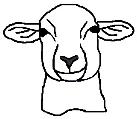
| Ears will generally be at parallel to the ground (depicted to left) or above parallel (pictured right on a young Mouflon ram lamb). Sheep which naturally have ears below parallel to the ground are disqualified from registration |
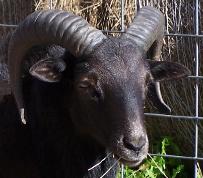
| Horned Ewe |
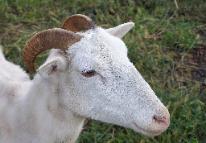


| Distinct Variegated Horns are a DISQUALIFICATION from registration as a Desert Sand Sheep |
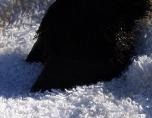
| Black Hooves This is a DISQUALIFICATION from registration for Desert Sand Sheep |

| White Horns CORRECT coloring of horns for Desert Sand sheep |

| CORRECT Both Testicles Normal and even |
| DISQUALIFICATION Both testicles did not descend Bilateral Cryptorchidism |
| DISQUALIFICATION One testicle did not descend Unilateral Cryptorchidism |
| FAULT Both testicles small sized but still functioning properly |
| FAULT One testicle smaller than the other |

| Weak Pasterns FAULT |
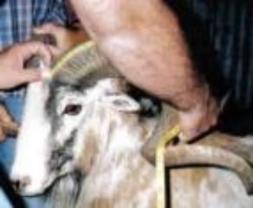
| Click on picture above to learn how to measure and score your ram's horns |

| Back Legs - Rear View |
| Correct |
| Bowlegged |
| Cow-Hocked |

| Scrotum/Testicles |
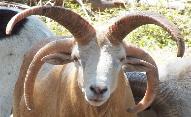
| NO SHEARING!! These sheep shed naturally! |
| General Anatomy |
| No Docking needed!! It's even a disqualification |
Please CLICK HERE to visit our NEW Website (effective 03/31/2021 for up-to-date information
Please CLICK HERE
to visit our NEW
Website (effective
March 31, 2021) for
up-to-date
information,
pictures, forms, and
list of members.
to visit our NEW
Website (effective
March 31, 2021) for
up-to-date
information,
pictures, forms, and
list of members.
Please CLICK HERE to visit our NEW
Website (effective March 31, 2021) for
up-to-date information, pictures, forms,
and list of members.
Website (effective March 31, 2021) for
up-to-date information, pictures, forms,
and list of members.